
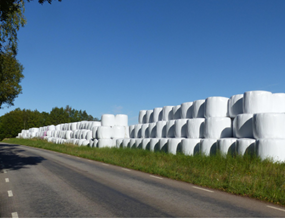
Inland New South Wales and Queensland expose agricultural plastics to intense sunlight, high daytime temperatures and long periods of dry weather. For silage producers, these conditions can accelerate polyethylene film ageing if the material isn’t formulated for demanding outdoor exposure.
High-performance silage plastic can use a combination of solar-reflective pigments and advanced UV stabiliser packages to reduce heat absorption while slowing photo-oxidative degradation. Titanium dioxide (TiO₂) fillers can increase solar reflectance, while Hindered Amine Light Stabilisers (HALS) help interrupt the chemical reactions that progressively weaken polyethylene.
Why Solar Radiation Matters for Silage Plastic
Silage film remains exposed to sunlight for weeks or months while protecting valuable forage. UV radiation can trigger photo-oxidation in polyethylene, producing chemical changes that eventually contribute to cracking, embrittlement and loss of mechanical performance. Research on agricultural polyethylene films has shown that UV stabilisation can significantly improve property retention during outdoor exposure.
The challenge is greater in arid inland environments, where intense solar exposure combines with substantial daytime heat. A film that absorbs more solar energy can develop a hotter surface than a more reflective formulation, increasing thermal stress on the polymer.
This is why solar-reflective, high-performance silage plastic inland Australia is increasingly relevant for operations exposed to harsh seasonal conditions.
How Titanium Dioxide Helps Control Heat
Titanium dioxide is widely used as a white pigment because of its strong light-scattering properties. Research on TiO₂-filled HDPE shows that adding TiO₂ can substantially increase solar reflectance and improve cooling performance under solar exposure.
In a silage film formulation, the objective is not simply to make the plastic appear white. The pigment must be properly dispersed and selected as part of the complete polymer formulation.
A reflective outer layer can help reduce the amount of incoming solar energy the film absorbs. This can help limit excessive surface heating, particularly when silage is stored in open paddocks with little shade.
Why HALS Are Important
Protecting the Polymer From Photo-Oxidation
TiO₂ and other reflective components address the optical and thermal side of solar exposure, while HALS work through a different mechanism.
HALS do not primarily function by absorbing incoming UV radiation. Instead, they help intercept reactive free-radical processes associated with polymer photo-oxidation. Studies of agricultural polyethylene films have found that HALS can reduce chemical degradation and help retain elongation and surface integrity during weathering.
A properly designed high-performance silage plastic therefore benefits from treating solar protection as a system rather than relying on pigment alone.
Choosing Film for Inland NSW and Queensland
When comparing silage films for inland Australian conditions, consider:
● Solar reflectivity: Helps limit solar energy absorbed by the film.
● UV stabilisation: Look for a documented stabiliser package rather than a generic UV-resistant claim.
● HALS performance: Important for slowing photo-oxidative damage in polyethylene.
● Film construction: Multilayer or co-extruded structures can allow different layers to perform specific functions.
● Mechanical strength: Reflective and UV protection should not replace adequate puncture, tear and stretch performance.
● Weathering evidence: Ask suppliers for relevant accelerated-weathering or field-performance data.
Chemical exposure can also affect stabiliser performance. Research shows that some agricultural chemicals can accelerate degradation of unstabilised polyethylene, so stabiliser selection must account for the intended environment.
Conclusion
A high-performance silage plastic designed for inland Australia should address both heat and UV exposure. TiO₂-based reflective technology can reduce solar absorption, while HALS help slow the photo-oxidative reactions that damage polyethylene over time.
For producers in inland NSW and Queensland, ask film suppliers for technical information covering solar reflectance, UV stabilisation, polymer construction and weathering performance. Choosing a solar-reflective, high-performance silage plastic for inland Australia, grade-matched to local conditions, can provide a more technically appropriate barrier for exposed silage storage.
—
FAQs
1. What is high-performance silage plastic?
High-performance silage plastic is agricultural polyethylene film engineered with properties such as high stretch, puncture resistance, UV stability and suitable barrier performance.
2. How does titanium dioxide improve silage film?
TiO₂ can increase solar reflectance by scattering incident radiation, potentially reducing the polymer film’s solar heat absorption.
3. What do HALS do in silage plastic?
HALS help slow photo-oxidative degradation by interrupting free-radical reactions within the polymer.
4. Why is UV protection important in inland Australia?
Extended exposure to strong sunlight can accelerate polyethylene photo-oxidation, contributing to loss of flexibility, cracking and reduced mechanical performance.
5. Is reflective film suitable for all silage applications?
Not necessarily. Film selection should consider the storage method, local climate, required mechanical properties, UV exposure and the manufacturer’s technical specifications.